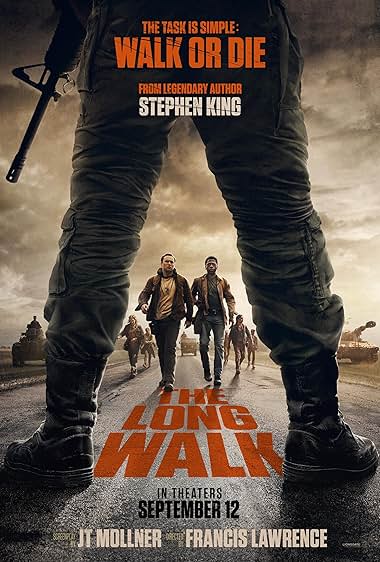
The Long Walk (2025)
Trailer
Synopsis
During a grueling yearly competition dubbed "The Long Walk," a group of male youths must endure a relentless march. To survive the event, each participant must constantly maintain a strict minimum pace, as any drop in speed results in immediate execution.
AuntieWoke uses advanced AI to help keep your family safe, but it can make mistakes. Please use your own judgment.
Woke Score Breakdown
🎭 Race-swapped character
2Several main characters who were originally depicted or understood as white in Stephen King's 1979 novel are portrayed by non-white actors, including David Jonsson as Peter McVries, Tut Nyuot as Arthur Baker, and Ben Wang as Hank Olson.
🔃 Gender-swapped character
1No established characters or ensembles are recast as the opposite sex; the contestants remain an all-male group of teenage boys, and authority figures like the Major are kept male.
👥 Diverse casting
2The fifty contestants in the film feature a visibly diverse lineup of Black, Asian, and Indigenous actors (including David Jonsson, Tut Nyuot, Ben Wang, Jordan Gonzalez, and Joshua Odjick), which presents a significantly more multicultural group of American youth than the homogenous white roster depicted in the 1979 source novel.
✊ Racial messaging
1The film focuses its narrative on authoritarian control, survival, and companionship without incorporating themes of systemic racism, white culpability, or racial grievance.
🛂 Immigrant themes
1Immigration, open borders, and the immigrant experience are entirely absent from the film.
🪶 Indigenous peoples
1Although the character Collie Parker is portrayed by Indigenous actor Joshua Odjick, the movie does not explore native-peoples issues, colonization, or cultural survival.
🏳️🌈 LGBT characters
1While some viewers and critics have highlighted a strong homosocial intimacy or potential homoerotic subtext in the close bond between Ray Garraty and Peter McVries, there are no overtly LGBT characters, relationships, or identity themes given weight.
♀️ Feminist themes
1The movie does not feature feminist or female-empowerment messages; the narrative is almost entirely male-centered, and its critique of authoritarianism and competitive masculine expectations is dramatized through male solidarity and brotherhood rather than feminism.
🏢 Anti-capitalist themes
2The film incorporates minor anti-capitalist themes through opening text and dialogue that establish the deadly walk as a desperate means of escaping economic deprivation, critiquing how a ruthless system exploits desperate young men for cash prizes and national productivity.
🌱 Environmental issues
1There are no environmental or climate-related themes or moral arguments present in the film.
Content Rating Breakdown
💋 Sex & Nudity
MildThere is no explicit sexual content or intercourse. Content is limited to brief non-sexual rear/buttock nudity, occasional crude jokes, and verbal references to sexual desire, prostitutes, and oral sex during conversations between the walking boys.
🩸 Violence & Gore
SevereThe film features graphic, bloody violence and body horror. Numerous characters are executed on-screen by gunshot, resulting in bloody head wounds and heavy blood splatter. Additionally, a boy's legs are run over and crushed by the treads of a military tank while he screams in agony, a character commits suicide by stabbing himself in the throat with a utensil, and there are highly detailed close-ups of severely bloodied, blistered, and deteriorating feet.
🤬 Profanity
SevereStrong and crude language is pervasive throughout. The dialogue contains hundreds of uses of the word 'f--k' (and its variations), alongside frequent use of 'motherf--ker,' 's--t,' 'a--hole,' 'b--ch,' and several homophobic slurs exchanged as insults.
🍺 Alcohol, Drugs & Smoking
MildSome background characters and soldiers are briefly shown smoking tobacco cigarettes, and there are occasional verbal references to drinking alcohol.
👻 Frightening & Intense Scenes
SevereThe film maintains a continuous, high-stress atmosphere of sustained peril and dread. Characters experience severe psychological breakdowns, suffer agonizing physical exhaustion, plead desperately for their lives, endure seizures, and resort to suicide to escape the hopeless nature of the walk.