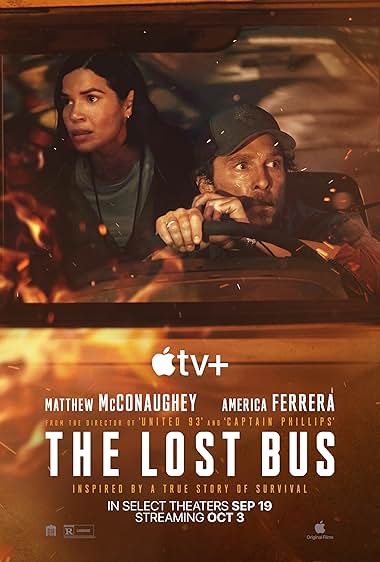
The Lost Bus (2025)
Trailer
Synopsis
Loosely inspired by real events, this narrative is set during the 2018 Camp Fire in Paradise, California, recognized as the state's most lethal wildfire on record. When twenty-two elementary school children are trapped at their campus because their families cannot reach them ahead of the advancing flames, a lone school bus driver attempts to evacuate the students and a teacher. Together, they must navigate a perilous path to safety while surrounded by the intense fire.
AuntieWoke uses advanced AI to help keep your family safe, but it can make mistakes. Please use your own judgment.
Woke Score Breakdown
🎭 Race-swapped character
1The cast aligns with the demographic makeup of Paradise, California, in 2018, and there's no indication of deliberate racial swapping.
🔃 Gender-swapped character
1No established characters are recast as a different gender.
👥 Diverse casting
1The cast appears to reflect the demographic reality of the Paradise community and the broader California population, rather than being assembled for diversity's sake. It appears representative of the setting.
✊ Racial messaging
1The narrative focuses on a disaster and the struggle for survival, with no overt messaging about systemic racism or racial grievance. The narrative does not foreground racial dynamics.
🛂 Immigrant themes
1There are no evident themes related to immigration or border policies.
🪶 Indigenous peoples
1The story is situated in a contemporary California setting with no explicit focus on indigenous peoples or colonial history.
🏳️🌈 LGBT characters
1There's no indication of LGBT characters or themes presented in the plot summary.
♀️ Feminist themes
2Mary Ludwig, the teacher, takes on a significant role in guiding and protecting the children and assisting Kevin, demonstrating a form of agency and responsibility; however, it's primarily functional to the survival narrative and doesn’t explicitly present a broader feminist message.
🏢 Anti-capitalist themes
1While PG&E's negligence is shown as a contributing factor to the fire, it’s presented as an element of the disaster rather than a core critique of capitalism.
🌱 Environmental issues
2The wildfire itself and Chief Martinez's discussion of increasing wildfires draw attention to the issue of climate change and the intensity of wildfires. It's less a moral argument and more a backdrop.
Content Rating Breakdown
💋 Sex & Nudity
NoneThe plot summary and available information do not indicate any depiction of sexual content or nudity.
🩸 Violence & Gore
ModerateThe film depicts scenes of peril and danger during the wildfire, including falling power lines, armed looters, and the bus navigating through flames. These scenes involve visible injury and distress, but are not presented with graphic detail. The descriptions indicate restrained depictions of these events.
🤬 Profanity
ModerateWhile the description doesn't explicitly mention the level of profanity, depicting conversations and interactions during a stressful situation suggests there could be instances of mild to moderate profanity. Nothing in the summary suggests constant or extremely intense language.
🍺 Alcohol, Drugs & Smoking
MildThe character Kevin struggles with personal issues and family relations, which occasionally includes a depiction of him drinking. While not central to the plot, this is noted in the description and warrants a mild rating.
👻 Frightening & Intense Scenes
SevereThe narrative revolves around a wildfire and survival scenario, featuring intense scenes of peril, gridlock, flames, and limited visibility. The plot summary emphasizes the frightening nature of the situation, which includes scenes of a bus navigating through a wildfire.